News
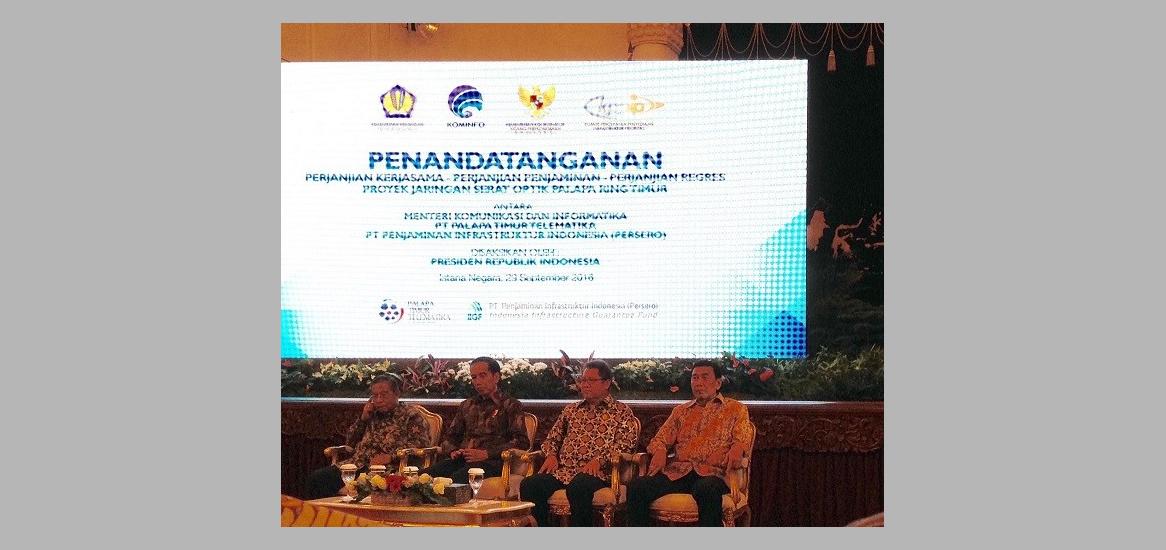
President Witnesses Signing of Palapa Ring Cooperation Agreement at State Palace
Jakarta | September 29, 2016
The Palapa Ring Program is the development of an information toll road network, consisting of both submarine and inland fiber optic networks, to districts/cities that desperately need the government's presence to reach broadband telecommunications networks, areas where telecommunications operators may not yet have the necessary infrastructure. The Palapa Ring development is divided into three development packages: the Palapa Ring West Package, the Palapa Ring Central Package, and the Palapa Ring East Package. A series of procurement processes for these three packages have been implemented according to sequential timelines. The West and Central Packages have achieved good progress, even ahead of the expected timeline.
Following up on the signing of the Palapa Ring Central Package Project between the Ministry of Communication and Informatics (KemKominfo) and PT Len Telekomunikasi Indonesia in March 2016, today, the Financial Close event was held at the State Palace, marking another milestone for this project. With this achievement, construction of the Palapa Ring Central Package Project can begin, with a target completion date of 2019.
In addition to the above achievements and following the signing of the West and Central Palapa Ring Project Packages in February and March 2016, today, the Cooperation Agreement for the East Palapa Ring Project was signed between the Ministry of Communication and Informatics (Kemkominfo) as the Project Contracting Agency (PJPK) and PT Palapa Timur Telematika (PT PTT), the Implementing Business Entity formed by a consortium of Moratelindo, IBS, and Smart Telecom. The signing was witnessed by the President of the Republic of Indonesia.
As part of the signing of this cooperation agreement, a Guarantee Agreement was also signed between PT PTT and PT Penjaminan Infrastruktur Indonesia (Persero)/PT PII, which implements the single-window policy of providing government guarantees for infrastructure projects in collaboration with the private sector, as well as a Regression Agreement between PT PII and Kemkominfo as the Contracting Agency.
The Palapa Ring Infrastructure Project is divided into three packages: (1) The West Package will cover the Riau and Riau Islands (as far as Natuna Island) with a total fiber optic cable length of approximately 1,980 km and a 15-year contract value of IDR 3.4 trillion; (2) The Central Package will cover the Kalimantan, Sulawesi, and North Maluku regions (as far as the Sangihe-Talaud Islands) with a total fiber optic cable length of approximately 2,647 km and a 15-year contract value of IDR 3.5 trillion; and (3) The East Package will cover the East Nusa Tenggara, Maluku, West Papua, and Papua regions (as far as the interior of Papua) with a total fiber optic cable length of approximately 8,454 km and a 15-year contract value of IDR 14 trillion.
The Palapa Ring project is one of the government's efforts to build the availability of fiber optic network infrastructure as the backbone of the national telecommunications system connecting all districts/cities in Indonesia. It demonstrates the government's commitment to meeting public infrastructure needs, particularly in the telecommunications sector, and accelerating the implementation of Strategic Infrastructure Projects/National Priorities stipulated in Presidential Decree No. 3 of 2016.
The Palapa Ring Project is being implemented under a Public-Private Partnership (PPP) scheme and is the first PPP to implement an availability payment (AP) scheme. The availability payment scheme was initiated by the Ministry of Finance, and AP funds are sourced from the Universal Service Obligation (USO) Contribution Fund.
The AP scheme, regulated by Minister of Finance Regulation No. 190/PMK.08/2015, is a periodic payment during the concession period based on the availability of infrastructure services built by the business entity. The AP components that can be paid are capital costs, operational costs, and a reasonable profit margin desired by the business entity. Under this scheme, the demand risk associated with the availability of infrastructure services is fully borne by the Contracting Agency (PJPK), namely the Ministry of Communication and Informatics. By assuming this risk, the business entity receives a return on their investment if they successfully meet the service criteria as agreed in the Cooperation Agreement. The continuity of payments from Contracting Agencies (PJPK) to business entities will be guaranteed by the government through PT PII.
With the Palapa Ring East Package Project, the final package after the West and Central Packages, the government will assist the Indonesian people in equitable distribution of broadband access throughout Indonesia. The Palapa Ring will also provide new business opportunities for Small and Medium Enterprises (SMEs) in remote areas, improve education through internet access, and improve people's standard of living through digital economic activities. (@nooriza_id)
News & image source:
Kominfo